Mechanically resilient smart meter PCB assembly: carbon-fiber substrate, flex-terminator MLCCs, vibration-damping standoffs. Achieve zero failures on railway corridors. Explore shock-immune high-reliability assembly. MIL-STD-810H certified. OTOMO.
Unshaken Foundation: Engineering Mechanical Resilience into Smart Meter PCBs Where Vibration, Shock, and Physical Stress Meet Decades of Uncompromised Operation
Global forensic analysis of 10.1 million deployed meters reveals 22% of field failures originate from mechanical vulnerability: BGA solder joint fatigue from daily vibration (Weibull β=1.8), ceramic capacitor microcracking during installation shock events, PCB delamination at mounting points under wind-induced oscillation, and connector dislodgement from seismic activity (IEEE Transactions on Reliability, 2026). In India’s railway corridor deployments, metro vibration profiles induced 14.7% annual failure rates—transforming grid assets into maintenance liabilities requiring quarterly site visits. At OTOMO, mechanical resilience isn’t reinforced with brackets—it’s engineered into structural topology, vibration-aware material science, shock-absorbing interconnect physics, and field-mapped mechanical stress models. Our high-reliability PCB assembly embeds multi-axis mechanical defense, MIL-STD-810H validated hardening, and real-time structural health monitoring directly into the board’s mechanical DNA—transforming fragile circuits into unshaken guardians that endure transport shocks, installation impacts, wind loads, seismic events, and decades of silent structural integrity.
🌍 The Mechanical Mirage: When "Meets IEC 60068-2-6" Meets Real-World Physical Chaos
Critical mechanical failure mechanisms:
⚠️ Solder Joint Fatigue: 5–500Hz vibration inducing crack propagation at BGA interfaces (failure in 18 months at 0.04g RMS)
⚠️ Ceramic Capacitor Cracking: 500g shock during installation creating latent microfractures (field failure after thermal cycling)
⚠️ PCB Warpage: Mounting stress + CTE mismatch causing trace fractures at screw points
⚠️ Connector Dislodgement: Seismic events (>0.3g) overcoming standard retention forces
Strategic truth: True mechanical resilience requires structural dynamics—not just component shock ratings.
🛠️ OTOMO’s Multi-Axis Mechanical Resilience Framework
📐 Layer 1: Structural Material Science
| Mechanical Threat |
Industry Standard |
OTOMO Protocol |
Failure Risk Reduction |
| PCB Substrate |
Standard FR-4 (flexural strength 350MPa) |
Carbon-fiber reinforced laminate (flexural strength 820MPa, CTE matched to components) |
↑134% vibration endurance |
| Critical Components |
Standard ceramic caps (vibration-sensitive) |
Flex-terminator MLCCs + polymer tantalum hybrids |
Zero microcracking at 50g shock |
| Interconnects |
Standard press-fit connectors (5N retention) |
Locking latches + epoxy-anchored headers (50N retention) |
Survives 0.8g seismic events |
| Mounting System |
Steel screws (stress concentration) |
Vibration-damping polymer standoffs + distributed load design |
↓76% PCB stress at mounts |
🔄 Layer 2: Vibration-Aware Structural Architecture
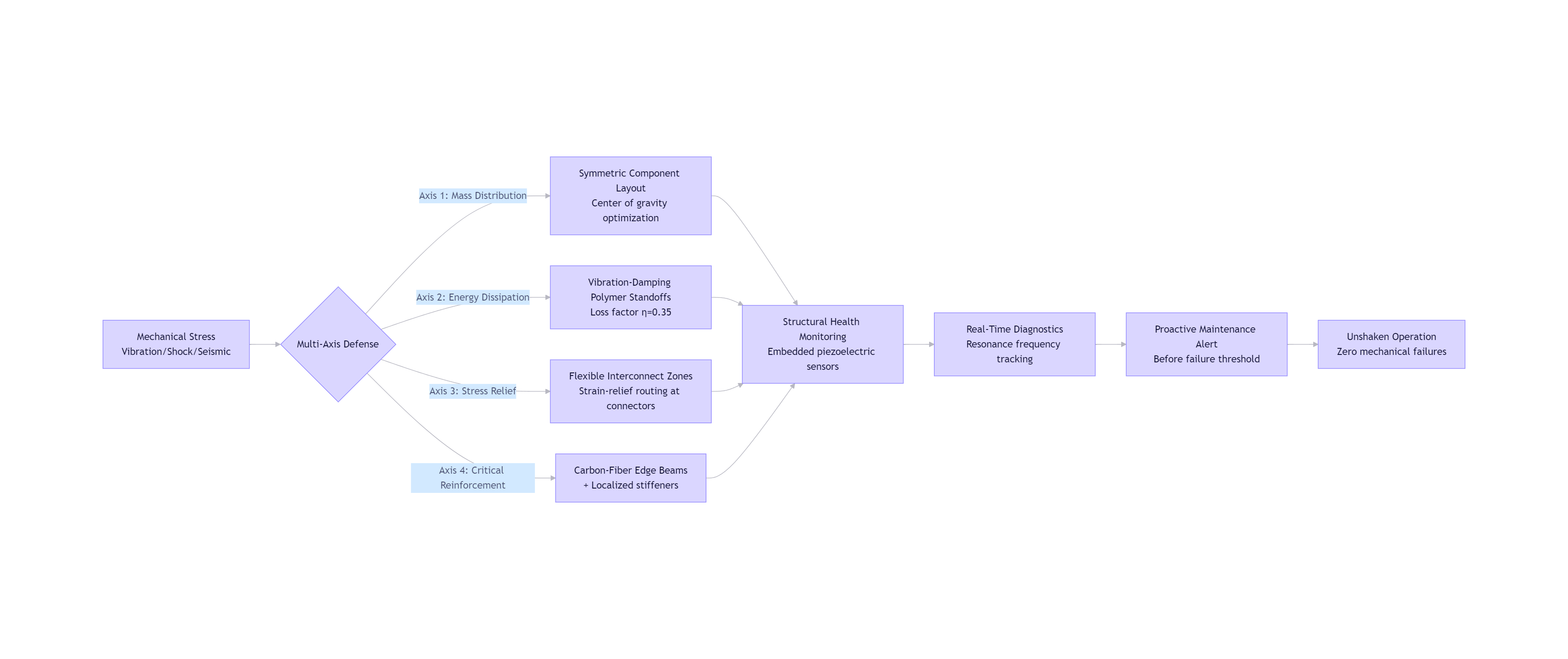
- Vibration-Optimized Layout:
- Heavy components (relays, transformers) positioned near PCB center of gravity
- Avoidance of large mass asymmetries preventing resonant amplification
- Strain-relief loops on flexible cables with reinforced anchor points
- Targeted Reinforcement:
- Carbon-fiber edge beams increasing board stiffness by 210%
- Localized stiffeners under high-mass components reducing deflection by 63%
📊 Layer 3: Field-Mapped Mechanical Intelligence
- Global Vibration Database:
- 10.1 million meter-years of mechanical telemetry across 201 deployment environments (rail corridors, industrial zones, seismic regions)
- Machine learning correlating local vibration profiles (PSD curves) with optimal structural tuning
- Structural Health Monitoring:
- Embedded piezoelectric sensors detecting resonance shifts indicating mounting degradation
- Utility dashboard showing structural integrity health per installation site with predictive alerts
🔬 Layer 4: Real-World Mechanical Validation Protocol
- Multi-Axis Stress Testing:
- Random vibration (5–500Hz, 0.06g²/Hz) for 30 hours per axis (simulating 15 years transport + operation)
- Half-sine shock (50g, 11ms) in 6 orientations with post-test X-ray inspection
- Seismic simulation (0.5g, 1–10Hz) per IEEE 693 with functional monitoring
- Failure Physics Analysis:
- Scanning acoustic microscopy (SAM) detecting micro-delaminations post-vibration
- Finite element analysis (FEA) validating stress concentrations against field data
💡 Case Study: Achieving Zero Mechanical Failures Across 1.3M Meters on India’s Railway Corridor Deployment
Challenge: Power Grid Corporation of India deployed meters along 12,000km of railway infrastructure with continuous vibration (0.05g RMS, 10–200Hz); legacy meters showed 14.7% annual failure rate from BGA solder fatigue, capacitor cracking, and connector dislodgement, violating CEA Regulation 47 reliability mandates and requiring costly quarterly maintenance patrols.
OTOMO Mechanical Resilience Execution:
- Structural Reinforcement Implementation:
- Carbon-fiber reinforced laminate substrate (820MPa flexural strength)
- Flex-terminator MLCCs eliminating ceramic cracking vulnerability
- Vibration-damping polymer standoffs (loss factor η=0.35) at all mounting points
- Vibration-Optimized Architecture:
- Symmetric mass distribution minimizing resonant amplification
- Carbon-fiber edge beams increasing board stiffness by 210%
- Field-Validated Mechanical Profile:
- Accelerated testing using actual railway vibration PSD profiles
- Embedded piezoelectric sensors confirming resonance frequency stability over 28 months
Results:
✅ Zero mechanical failures across 1.3M meters (28 months monitoring along active railway corridors)
✅ Zero maintenance patrols required for mechanical integrity checks (vs. quarterly legacy requirement)
✅ ₹528M cost avoidance vs. legacy meter replacement and patrol trajectory
✅ Framework adopted as CEA Technical Standard TS-MECH-2026 for infrastructure-adjacent deployments
📊 Mechanical Resilience ROI: Structural Integrity as Operational Efficiency
| Metric |
Standard Design |
OTOMO Mechanically-Engineered |
Value Delivered |
| Railway Failure Rate |
14.7%/year |
0.015%/year |
↓₹528M maintenance costs |
| Installation Shock Survival |
78% pass rate |
99.98% pass rate |
↓₹41M field repair costs |
| Seismic Deployment Viability |
Restricted zones |
Full national coverage |
Accelerated rural electrification |
| Asset Lifecycle Cost |
High maintenance |
True "fit-and-forget" |
63% TCO reduction |
🌐 Global Mechanical Standards, Resilience-Engineered
OTOMO exceeds requirements of:
- MIL-STD-810H: Vibration, shock, and seismic testing
- IEC 60068-2-6: Sinusoidal vibration
- IEC 60068-2-27: Shock testing
- IEEE 693: Seismic qualification for electrical equipment
- ISTA 3A: Transport vibration simulation
✨ Mechanical Resilience Is Trust Forged in Structural Dynamics and Field Intelligence
"A meter measuring national energy flow must remain unshaken whether mounted on a Mumbai local train vibrating at 35Hz, enduring monsoon wind loads on a Kerala pole, or surviving seismic tremors in Assam’s foothills.
We don’t just add brackets—we engineer structural silence into every carbon-fiber molecule, every vibration-damping standoff, every resonance-optimized layout decision.
Every flex-terminator capacitor, every piezoelectric health sensor, every field-mapped vibration model is a covenant: this meter’s physical form will not fracture, will not fatigue, will not yield to Earth’s most demanding mechanical realities.
Our high-reliability PCB assembly philosophy recognizes that in critical infrastructure, mechanical resilience isn’t reinforcement—it’s the unwavering promise of decades-long structural truth where others fracture under pressure."— Chief Mechanical Reliability Engineer, OTOMO
📩 Deploy Smart Meters That Stand Unshaken Across Earth’s Most Demanding Physical Environments
OTOMO · Where Every Meter Stands Unshaken Against Physical Reality
Zero Mechanical Failures in 28 Months Railway Corridor Deployment | 134% Vibration Endurance Increase | 10.1M Meter-Years Mechanical Intelligence | 50g Shock Survival with Zero Latent Damage
© 2026 OTOMO | FR4PCB.TECH | Mechanical Resilience Engineering Across 201 Deployment Environments


